Tuesday, July 03, 2012

Moodle: The Corporate Reality Uncovered


The popularity of Moodle as an academic learning platform is now migrating into the corporate market too. But, built originally for an academic audience and learning model, what’s the reality of Moodle’s usage and suitability for corporate learning?


Here's an Extract from our Corporate Moodle Report Summary:

Moodle’s Origins 
Historically, Moodle has been primarily used within the academic community as a virtual learning environment or VLE, a software system designed to support teaching and learning in an educational setting. Virtual Learning Environments such as Moodle are designed to deliver a programme of learning and its associated activities over a period of elapsed time, with one or more facilitators/tutors interacting with students, and with focussed interaction between students. Whilst a VLE does provide some management functionality and some content functionality, its primary role is to support the delivery of learning, through a structured educational programme, resources and collaborative activities. 

Moodle’s Place in the Market Today? 
There is no doubt that there is significant interest in the potential to use Moodle for corporate learning, but our  research shows that corporate usage of Moodle today is quite limited, and there are still very few public domain large-scale corporate Moodle case studies. Unlike the academic community, few corporate organisations have yet adopted Moodle as a strategic learning technology platform. And if they have, Moodle is typically just one component of a more traditional learning technology infrastructure (alongside a learning management system and other virtual learning/elearning tools).
From our research, the most common role of Moodle within corporate organisations today is as a tactical, low- cost elearning launch platform where an organisation does not have a suitable LMS already. Some organisations have used it on a more extensive scale but even then it is for a distinct audience or to meet a specific need. 
Despite Moodle’s success in the academic market, where it has become established as a common platform to  manage the delivery of educational programmes with facilitating tutors, there is limited evidence of corporates  using Moodle to deliver a blended approach.   This should probably not be a surprise, as a real commitment to blended delivery is often lacking in corporate training, irrespective of the available delivery platforms. 
For the sake of clarity, here the word “corporate”, doesn’t mean quangos or small to medium companies, but is used to describe large private sector companies with enterprise scale operations. 
The use of Moodle as a collaborative learning platform or conventional VLE within a corporate environment is also limited, with few good reference examples. In this guise, Moodle is being used for collaborative activities and tutor facilitation, but not generally to manage the overall blended programme. Whilst this type of usage  is growing, it will be slow relative to Moodle’s overall growth, as corporates slowly shift to blended and virtual learning as a mainstream approach. 

The Future of Moodle
There is strong evidence that Moodle can provide a tactical elearning launch platform, and interest in using Moodle as a broader lightweight LMS solution is growing. But currently, Moodle, unless significantly modified, lacks the functionality to manage this effectively in a corporate training/learning context.  Nothing illustrates this more than the decision to develop Totara and the other commercial distributions of Moodle.  In almost all corporate deployments, Moodle has been heavily customised by partners and independent vendors, and even now, the enhanced functionality that’s needed is part of vendor modules, rather than core Moodle code.


Learn More
To learn more about Corporate Moodle, you can access our latest free research report.  This provides 40 pages of insight into the Moodle supply chain, the challenges involved for end user organisations when implementing it as a solution, the functionality profile and the development of Corporate focussed Moodle distributions:


Insights into Corporate Moodle


http://delivr.com/1hs98

Thursday, May 24, 2012

The impact of talent management acquisitions on corporate HR strategy

We’re releasing a new Insights Report today which reveals the impact on corporate customers and competing vendors of the recent billion dollar acquisitions of talent management providers SuccessFactors and Taleo, by SAP and Oracle.

The report analyses the immediate aftermath of these and other acquisitions in the talent systems market. It explores the underlying trends and drivers behind the acquisitions, the broader effects that consolidation is likely to have on the talent management market, and the impact on corporate customers and their HR systems strategy.


Rather than just discussing the SAP and Oracle acquisitions in isolation, we feel it’s important to understand what’s driving these big market changes, and most critically, what they mean for corporate customers. But these big questions haven’t really been discussed in-depth until now. The report highlights that the market changes are as much driven by the potential opportunities of Cloud computing, as they are by the importance of talent management itself. Corporate HR, talent management and learning and development teams still remain uncertain about the impact of these changes on their strategy and day to day operations, as well as their scope of choice when making purchasing or upgrade decisions.

At one of our recent roundtable events, a number of large European corporates expressed confusion and real concern about the future of the HR and talent systems market. We know that many corporates have abandoned their original vision of a single all-encompassing ERP/HRMS in favour of a best-of-breed approach for talent management, learning, and recruitment. Most attendees had reservations about the role of the ERP vendors in the talent market, and the potentially negative impact on innovation and user experience.

Historically these decisions were made at a specialist talent level within HR. But there has been a definite shift towards hybrid learning and talent platforms. However, most European corporates are still a long way from having a unified view of their talent processes. There is also little doubt that the market consolidation is already impacting corporate strategy and choices.

You can download a free copy of the report here: http://delivr.com/1gwwy

Thursday, May 10, 2012

Moving beyond 70:20:10 - Reflections on the LSG Webinar

What is 70:20:10?
Following my recent webinar on ‘Moving beyond 70:20:10’ for the Learning and Skills Group, I wanted to delve a bit deeper into this high profile model.
Some L&D professionals build impassioned cases around it, in a desire to support informal and social learning, whilst others view it as a dangerous over simplification.
So I wanted to reflect on its usefulness in more detail.
I’m sure if you’re reading this that you’re familiar with the concept of the 70:20:10 model but just in case, Charles Jennings provides us with a great explanation:
“About 70 per cent of organisational learning takes place on the job, through solving problems and through special assignments and other day-to-day activities. Another 20 per cent occurs through drawing on the knowledge of others in the workplace, from informal learning, from coaching and mentoring, and from support and direction from managers and colleagues. Only 10 per cent occurs through formal learning, whether classroom, workshop or, more recently, e-learning.”
Charles also provides a spectacularly good overview of the model in this video too: http://www.youtube.com/watch?v=t6WX11iqmg0

Miss-used and Abused?
Now, the model is a very useful lens to think about what Learning really means in organisations. 
But as much as the model is useful, it can be abused and it’s mis-use has a number of risks:
  1.  How much does it create the expectation that you should be doing less formal training? And is it used as an excuse to reduce training headcount?
  2. How well does it directly translate into all corporate learning contexts – all of the time
  3. Is learning on the job an option if you need people to be proficient from day one of a new process, product or systems launch?
It can be used to assume the answer before you have even asked the question!

What are the Key Factors for the Best Learning Mix?
To prescribe learning solutions without taking into account the specific context or requirements is far from ideal. So it’s at this point I like to take a step back and think about what factors drive the best mix of learning delivery?
I asked this during the webinar session and the attendees provided their insights such as:
  • The needs of the business or customer
  • Audience profile
  • Learning styles of the group
  • Learning needs, characteristics of target group, the 'logic' of the content, culture
  • Practical elements such as geographical spread, audience demographics, technological constraints
  • The immediacy of results required by the business tends to drive the mix
  • Transfer of knowledge into work
  • Knowledge transfer vs. skills.  Are you passing on information, or building skills/practices in the workplace?
This, it seems, it what really matters to learning and development professionals, more than any kind of model. It is about finding what works best for learners in a particular situation. The absolutes of 70:20:10 should never be taken as hard and fast parameters.  The combinations need to flex and potentially flex considerably if they are to fit what’s really needed.  And that’s why we need to retain the uniqueness of each project we support from organisation to organisation, between business units and, role by role.  Project by project not all of the answers are found it 70:20:10. 
CONTEXT is KING… and we surrender this to any model at our peril.   
So, why is 70:20:10 important?  

What is the Power of 70:20:10?
The power of the model is it helps remind us that learning is a process.  That is it not bound to a single channel.  It happens over time, from a variety of sources and is supported by real world experience, motivation and feedback. 
What learning and development practitioners all too often deliver is  a single event, whether that’s face to face, or online   70:20:10 enables us to lift our focus out from short term events out to how we support learning back in day to day working life. And that’s really important because this is where learning becomes performance.  And that is what we are really all about - Performance Development.
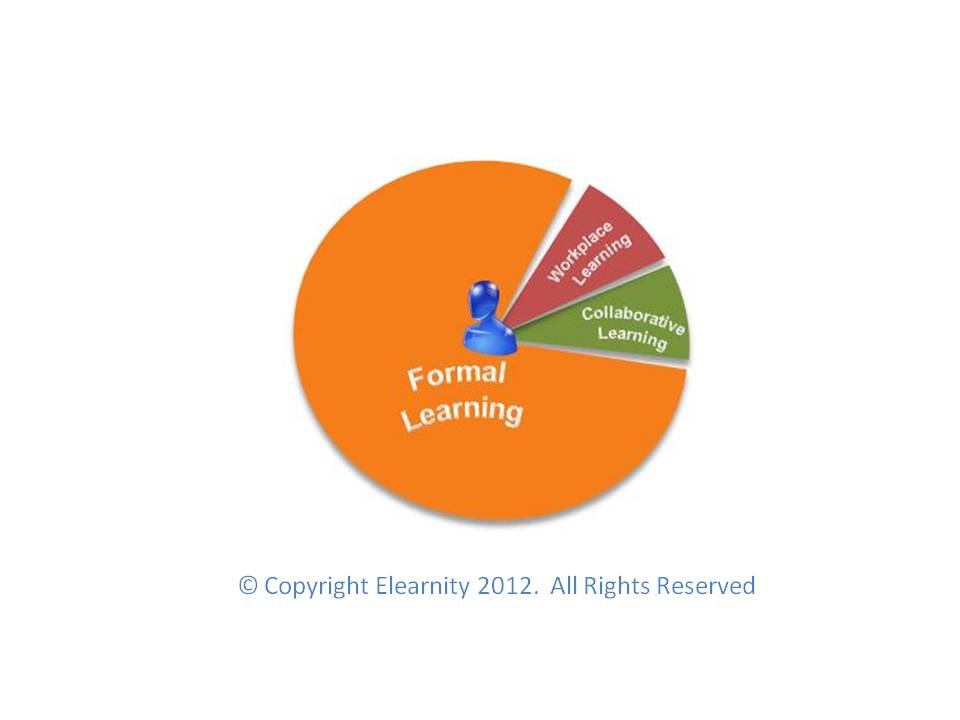
 A performance development view has to embrace a full mix of the components: workplace learning, formal learning and collaborative learning.  And using these labels are potentially much, much, much more useful that quoting 70:20:10.  
If we think about learning in those terms then we can start to picture the extent to which learning is really supported in organisations.  Not an ideal and in appropriate set of percentages.
Often the split of effort across organisational learning currently looks like this:
However, if we want learning to be really effective in improving performance, we need to be moving towards a more even split in our efforts, resources and investment to support ALL learning.

Only by investigating how we can address, formal, workplace and collaborative learning, for critical roles in our organisations, can we start to piece together how we should be investing in our learning approach to drive real impact. 
And as we start to look in detail at the opportunities to support learning and we can start to see that the learning armoury, the wealth of tools, platforms and channels can be much more complete, than formal delivery alone. 

Moving Beyond 70:20:10?
This is what I mean by ‘moving beyond 70:20:10’.
We’re starting to transcend any perceived boundaries of a model and broaden our thinking beyond merely splitting learning across formal instructor-led sessions, a bit of e-learning and a spot of performance support. 
We’re thinking more about the big picture for the organisation as a whole and how we can choose from different types of learning to best support an overall vision and strategy.   We start to look at our technology choices and infrastructure in a way that drives real value and makes ordinary working lives better.  Not because they were trained but because they were given the support to really learn.
As one participant in the webinar put it, we can ‘develop a pick and mix approach to suit each context as one size will not fit all’. For different learning requirements we need to ask key questions such as:
  •  What channels are appropriate in this context?
  • How do they add value?
  • What is technically feasible?
The spirit of the 70:20:10 model is incredibly useful in helping us to think about incorporating different channels in our L&D strategy. It can really help our learners by providing different learning opportunities, but ultimately it seems that context is king and we need to build some flex into how we apply 70:20:10 as we move L&D into the future.
Only by thinking about and acting to support all learning, be that workplace, formal and collaboration, will L&D really be able to really say they are driving tangible improvements in performance.   Without it L&D are just another cost.  And costs eventually get cut.


Thursday, April 19, 2012

LSG Webinar: Moving beyond 70:20:10: Building a context-driven learning strategy

One of the most popular terms used in L&D today is 70:20:10. Talk to almost any L&D leader and they will say it’s the foundation for their Learning Strategy. 

But, how useful is the 70:20:10 model in really helping you build a practical learning strategy and architecture? 

How do you move beyond the numbers and start to build a context-driven approach to performance development? 

Based on Elearnity’s corporate research, David Perring will explore:
 
· The danger of absolutes and how learning context is King
· Approaches to visualising your Learning Strategy and why it's important
· Mapping your Learning Ecosystem
· Taking a role based view – matching learning architectures to learner contexts
· How to assess the real opportunities of innovations, such as Mobile Learning


If you missed David's presentation today for the Learning Skills Group, you can download the presentation deck (minus the technical difficulties) using the following URL.

http://delivr.com/1fo55

For further reading You can also download our Mobile Learning Insights paper.

http://delivr.com/1fo1p


Wednesday, April 04, 2012

Thanks Taleo Research: A Few Talent Experts You Should Follow

Here's a very nice extract from a blog post on the Taleo Research blog called A Few Talent Experts You Should Follow. David Wilkins, Taleo's VP of Research, wrote this following attending our Symposium roundtable event in London on the 28th March.

Elearnity Symposium, David Wilson, and David Perring

For those of you in the US who haven’t heard of Elearnity, it’s time to take notice.  These guys know their stuff, and they host an amazing event.  Both David’s know the European market cold and they know learning – not just the technology, but the design, implementation, and strategy side as well.  And they have been around this stuff for as long as or longer than me – which is saying something.

That experience brings moderation and insight.  They’ve seen it all, probably tried most of it, and then settled on what’s worked – they know that new technologies usually don’t displace old ones overnight, and that the often more pertinent questions are “what new problems does a change in technology help us solve?” and “what existing problems are better solved with new technologies or new approaches?” and most importantly, “what still works just fine the way it is?”  Like I said, moderation and insight.  It’s a rare trait among thought leaders to evangelize new approaches in a thoughtful, balanced way, but that’s what they do, and it’s why I respect them as much as I do.  They “get it” in ways that most folks don’t.  Needless to say, you should follow these guys and pay attention to what they say.  Even more so if any part of your company does learning in Europe since that is their home turf.

Given the above backdrop, it shouldn’t be surprising that these guys think about events differently too.  Here’s how the Elearnity Symposium works:  round tables at which multiple vendors and multiple talent practitioners sit.  The practitioners kick off a discussion topic that they are collectively interested in discussing from a list of about 40 suggested subjects (all based on questions and insights from the Elearnity consulting practice), and the vendors then share their thoughts and perspectives.  Perspectives lead to dialog and conversation, and in this exchange, buyers and practitioners get a sense for the vendors’ worldviews and directions, and vendors get a broad sense of the overall issues facing the market.  20 min per table, then the vendors switch to a new table and new set of questions.  Rinse and repeat three times per session across three sessions.

After participating in just two of these sessions, I had more info and a better sense of the market than I could have gotten in multiple days’ worth of client and prospect meetings.  And for the talent management practitioners, they heard more collective expertise about market trends, exemplars, and best practices than they would get in multiple days at a conference.  Here are just a few of the topics that we discussed:
  • The trend toward “learner-centric” approaches and what they mean from a strategy and design perspective.
  • Planned adoption, roadblocks, strategies, and directions related to mobile learning.
  • Key design principles and best practices in blending formal, social, and informal learning models.
  • Key causes for LMS implementation failures or “failure to meet expectations.”
  • Platform discussions regarding the pros and cons of enterprise social platforms vs. social tools inside the LMS.
Good stuff right?  What was great about this exchange was that format fostered honesty and authenticity.  It was also pretty obvious which vendors knew their stuff after just one or two rounds of discussion, and which ones were just serving up talking points.  It was equally obvious where the practitioners were in their adoption curve for emerging trends.  If you’re based in Europe, this is definitely an event to check out next year.  If not, I’d still follow the Elearnity team – David Wilson and David Perring in particular.  They know their stuff, they know what matters in the trends that are happening, and they can give sage advice about how to get “there” from “here.”
Thanks David ... we appreciate the positive comments. 

Here's more information on the roundtables on our website. Please contact us if you are a UK/European Enterprise-class organisation and would like to be involved in future research discussions and roundtables.


Wednesday, February 29, 2012

Choosing the Perfect Talent Management Solutions Partner?

So, the dust has settled on the Learning Technologies event and no doubt attendees have gone back to the office with a bag full of leaflets to look at some time in the future. And exhibitors will have returned to their HQs with fists full of business cards to follow up. You might have just put all your leaflets straight in the bin, they might be sat buried in your in-tray, or you might even be having conversations with some of the companies you met about how you could work together.

But, how do you get from these early stages of speed dating at a show, to actually finding your ideal match?

How do find that partner who can create a sustainable, long term impact and a great working relationship that will be valued for years?

No 1- Know and Communicate Your Goals

The single most important aspect of finding the perfect partner is to really understand and communicate your business goals.  The measurable and tangible business targets that you need your partner to help you achieve. The more business aligned, real and robust these are; the more business critical and visible they are; the more likely your choices will actually deliver value. It really is pivotal.  If your objectives are vague, L&D centric - not focused on business returns, then even the greatest partnership and perfect partner will fail.  Without a solid foundation, even the best solution will end in a whimper of disappointment…

So, you need be business driven, tangible and geared to contribute visible business value, almost immediately.

Having this clarity of (measurable)  intent and communicating your goals clearly to your potential partners will be the most important thing you do.

Robust goals lead to robust solutions.


No 2 – Look for more than Functionality and Immediate Costs

So, now you know where you’re really going, you can look for your partner.

But what, makes a perfect partner?

During our recent webinar for the Learning and Skills Group, we asked two open questions about this topic.  The online discussion revealed some interesting insights:

‘What makes a good learning systems partner?’
The responses included words like ‘trust’, ‘good support’, ‘flexibility’ and ‘providing a good customer experience’. These are all answers based on the approach of the learning provider, their culture and their people. 

But when we then went on to ask the second question:

‘What are your key criteria when selecting a learning systems partner?’
The answers instantly changed. The focus shifted and the answers were suddenly all about the technology and the features and functionality that a system can provide. Responses included ‘integration with existing platforms’, ‘flexible reporting’, ‘regular upgrades’ and ‘simple navigation’.  


And thereby hangs the tale.

When choosing a learning provider – whether it’s for a system, a tool or e-learning content – there are two pivotal factors.  It’s critical to bridge the gap between the technology itself and the ability to deliver success.

Cost, preferably a view of total cost of ownership, is always a fundamental consideration of course, but other factors need to come into play as the answers to our first question demonstrate.

So, why is that so often, qualities such as user experience, support and flexibility get overlooked during the procurement process?

Some of this is driven by the procurement process itself.  The professional procurement and IT approach is to find the partner who matches your needs.  This is the low hanging fruit that is easy to quantify and potentially easiest to prove.  If the solution has the functionality then there is a view that the rest is a matter of contacting, SLAs and supplier management.

But, that doesn’t guarantee success or deliver long term impact.

The problem is that in order to deliver long term impact, there are some really critical factors that are so much more important than a functionality list.  These are the genuinely more elusive perspectives of how easy the vendors’ implementation team are to work, the ease and flexibility of solution configuration, the simplicity of administration, the scalability of their customer support to handle problems etc.

Providing insights into the breadth of understanding that is needed to make good Learning and Talent Technologies decisions is one reason we’ve created our Vendor Perspectives Reports.  They help bridge this gap.  They provide real, independent insights into these critical factors. So, now when you’re evaluating learning technology solutions, you’ve got a short-cut to expert insights, analysis and inside information that will help you make the right decisions.  Not just in the context of your reference call contact, but across many customer scenarios.

So, whether you are at the early stages of assessing learning solutions, or re-evaluating your existing options, our advice is to begin by considering the wider factors that are critical to success, in addition to your functional specifications.

For example:

Quality of user experience - across all system roles
Ease of delivery & technical execution
Enterprise flexibility & sustainability
Service capability
Total cost of ownership
Access to innovation

Many of these have long term impacts.  Business drivers change over time, and finding a partner who can move at the pace of your business with innovation, sustainability, ease of delivery, flexibility and with a ingrained quality user experience are some of the key factors that will mean that you’re not hunting for a new partner once the contract comes to an end.

As we’ve said many times in the past, functionality alone is never enough to drive successful partnership and valued solutions.


Finding the Perfect Partner – Your Perspectives
Whether you are a user or a supplier of learning technologies we’re keen to get your insights:

How effective have your solution selections been?
What goals are driving current solution searches?
How robust are they?
What experiences and advice would you give to others trying to choose their ideal partner?
What are the biggest mistakes people make?
What are your top tips?

We’d like to hear about them, post them here via the comments or on info@elearnity.com.
Or tweet me @davidperring.

Thursday, February 09, 2012

Learning and Skills Group Webinar

- Lessons in Choosing Your Ideal Learning Systems Platform and Partner


Whether its choosing an LMS or an e-learning authoring platform, organisations often spend many months researching the market and trying to select the right vendor partners. 

But even the best RFP process or functional requirements document is only part of the story, and organisations often still choose products that they struggle to implement or end up replacing within a short period of time. 

Based on Elearnity's corporate research, David Wilson discussed some of the key reasons why companies sometimes choose the wrong solutions or partners, and how to avoid repeating their mistakes.
  • What to look for in your potential vendors and how different are they anyway?
  • How useful is a Magic Quadrant?
  • Best of breed versus best fit and value for me
  • The key factors influencing successful outcomes
  • What are the bad scenarios, leading to bad choices?

If you missed the LSG webinar you can have a look at David's slide deck and get a sense of how to enrich your selection process and decision making.


For further reading You can also download our selection and procurement ViewPoint "Functionality Is not Enough", which will also give you additional insights into how to make successful selections.


Thursday, February 02, 2012

Get a Free Summary Perspective

Yesterday we put our first Summary Perspectives reports up onto our website. So, you can now download them for FREE!   No cost.

But, why would you want an Elearnity Perspective anyway? What are they?  Why have we published them?


Well, we know how time consuming and expensive vendor research can be - we do it all the time, reviewing solutions from the key players in the learning technology market to get an unbiased insight into the solutions they provide. Elearnity’s Vendor Perspectives are the only in-depth, independent analysis of learning technologies and innovation for organisations based in the UK and EMEA. 
These reports are invaluable whether you are:

  •  Assessing your options into new approaches
  •  Re-evaluating an existing solution
  • Keeping track of new suppliers and product, or
  • Simply re-affirming choices you’ve already made

We independently find out everything you need to know. 
So now when you’re evaluating learning technology solutions, you’ve got a short-cut to expert insights, analysis and inside information that will help you make the right decisions.  

If you would like to explore our Perspectives you can look at them at www.elearnity.com/perspectives.html.


Monday, January 23, 2012

Vendor Perspectives 2012


We're pleased to announce that Elearnity is publishing its first series of Vendor Perspectives. These new reports provide the only in-depth, independent analysis of learning technology vendors with a UK/European focus.
We've been analysing and advising on learning technology solutions on the front line for over 15 years, helping organisations such as Boots UK, Lloyds Banking Group and Vodafone choose the right vendor partners and achieve real results. Recognising the diverse and often complex nature of the learning technology market, the team has created Elearnity’s Vendor Perspectives to help organisations take a short-cut to understanding the realities of different vendor solutions.
Learning Technology is a specialist market, with a wide range of vendors offering competing solutions. Telling the difference between vendors is difficult. Whether you’re brand new to the market, or already have experience, it is still difficult to get an independent expert view of which vendors you should consider, and how good they really are at delivering in a complex environment. We’ve been helping corporate clients do this for years, but wanted to make this knowledge more accessible to a wider audience and help organisations to find the best solutions faster.
So what is Vendor Perspectives? 
Vendor Perspectives review solutions from key players in the learning technology market to provide an unbiased insight into the solutions they provide. The reports capture the experiences of Elearnity’s corporate research network, as well as analysis from our independent vendor briefings.  This is shared using ‘5-star’ ratings and analyst commentary of 30+ different factors covering: Market Presence and Scalability, Ease of Delivery, Enterprise Flexibility, Solution Capability, Corporate and User Experience, and Cost.
Uniquely, the Vendor Perspectives are created with a UK/European not US focus. Most research that is available is dominated by input from the United States. Within the UK and Europe, this information often has limited relevance and value; it is often quite superficial, and doesn’t focus on the specific challenges faced by multi-national companies, or the local capabilities of the vendors in Europe. That’s exactly what Elearnity’s Vendor Perspectives do.
To quote one of our corporate clients, Gary Bellamy, Head of Learning Technologies at Lloyds Banking Group, ”I have worked with Elearnity for a number of years because we simply couldn’t find the same in-depth knowledge of the learning technologies market anywhere else. The team has much real-world experience of seeing how solutions work in action which I have found invaluable when separating fact from fiction in the market. Anyone involved in implementing learning or technology solutions should use the Vendor Perspectives to get an independent and instant insight into the solutions that exist in the market today.”
We’re hoping that downloading the reports will save organisations the time and expense of carrying out research themselves, and assist in the decision making process by providing real-world insights and a level of detail you won’t find anywhere else (even if we do say so ourselves!). 
The first set of reports will cover core areas, with more to follow:
  •          Learning Management Systems (LMS)
  •          E-learning authoring systems
  •          Bespoke e-learning contentOur Summary Perspectives will be available from 1st February. So watch this space for updates and be the first to have a look at the very latest learning technology analysis and insight. 
Also see our website for more information.


Wednesday, December 14, 2011

Mobile Learning - All Talk?

What is the reality of mobile learning in corporate learning organisations?

At the start of 2011, it was widely thought that this would be the year when mobile learning, or m-learning, would reach a tipping point and become part of mainstream learning solutions.

So, surrounded by all the hype, what actually is the reality at the end of the year?

What is its role in the learning mix?

What are the key opportunities and challenges in the adoption of mobile learning technologies?


In this Insights Report we explore the realities of mobile learning in EMEA corporates; the trends, challenges and opportunities.

To download and read our free report, simply follow the link below.

http://www.elearnity.com/EKCLoad.htm?load=ByKey/DWIN8PJEHL


Wednesday, July 06, 2011

Providence looks to chalk up Blackboard for $1.64 Billion

It is thought provoking that an e-learning company would be worth $1.64 Billion, in cash. But that's exactly what Providence Equity Partnership have valued Blackboard for, in their recent acquisition offer.

Blackboard have historically been the dominant player in the educational VLE market, although over the past year they have been losing a significant proportion of their market share to open source alternatives such as Moodle and Sakai.
So, what does this mean for EMEA based corporates?
Is this shift in ownership going to create some ripples, this side of the pond?
In the short term, not really. Blackboard isn't a name that has really been that visible in the EMEA enterprise sector. Their academic model, hasn't attracted much interest outside of the academic world in Europe.
But, looking further out, this could be a turning point for Blackboard, and could mean the start of a a sea change in the LMS market.
With the Learning Management System market-place moving increasingly towards a more holistic, talent and performance story, corporate talent networks, and collaborative work-based learning approaches; Blackboard's VLE functionality could become much more attractive, if Blackboard moves some of its focus from managing semester based education programmes to supporting the corporate learning context.

Thursday, May 26, 2011

Augmented Reality and Learning

Augmented Reality seems to have hit the headlines. And if you aren't sure what that is, the ever popular Rory Cellan-Jones, has just produced an article for the BBC website explaining everything.

If you consider this technology through the eyes of Corporate Learning the potential impacts for Employee Performance Support (EPS) and Just In Time learning are massive; even truly mind boggling; especially in a technical environment and product rich environment where the learners could even be the customer.
But, who in the e-learning world is ready to address this opportunity?
With all the fixation on mobile content being about taking more traditionally focussed push and pull traditional materials to the learner, and collaboration this is obviously an opportunity for someone to exploit.
But, to some extent for developers of this Learning Content, it also means thinking about how you manage learning content very differently from how you do today. It will mean meta-tagging, data warehousing a rich set of assets... and I can't see most e-learning developers both internally for externally being nimble enough to be thinking less about layout on the screen and nice story based interactions and more about creating a rich, contextual learning ecosystem that is triggered at point of contact.
Augmented Reality could really revolutionise the way everyone one learns... and shift the reality of everyone in L&D... particularly those who have a product or physical context, but it means rethinking what the training departments is about and how it fundamentally operates...
Goodbye Articulate......
Hello... ????? well.. who knows...

Monday, February 28, 2011

Our Learning Technologies 2011 Videos

It's just over a month ago that we presented at the Learning Technologies Conference 2011.

In many ways it seemed like a distant memory; well that was up until Stephen Clee drew our attention to the conference videos that are now available online, and all the memories came flooding back - supported by the relevant slide deck..
Naturally, to anyone other than a complete egotist, the prospect of watching yourself back on video is about as comfortable a feeling as a queuing up for a triple root canal at your dentist.
Thankfully for the spectator tho, the videos are perfectly painless and pleasantly informative.
The Elearnity Presentations are in the links I've attached below, but the entire conference line up is available for your delectation.


It's not quite Oscar material, but it's entertaining all the same.

Enjoy.

David


Friday, February 18, 2011

The Fall and Rise of Academies

Over the past year we have seen a rise in focus on Corporate Academies.

What is interesting is that this appears to be being generated from a couple of different sources.
On the one hand it appears to be fueled by corporates wanting to provide a platform for corporate social networking, and on the other hand, they seem to have grown from "Capability" based Organisational Development (OD) strategies, where an academy provides a focus for introducing organisational competencies.
The power and opportunity of Social Media and collaborative tools is self evident. You only have to look at Neilsenwire's article on web-brands for Jan 2011 to see the comparative importance of Facebook. When combined with the impetus behind Organisational Development (OD) in HR, it looks, at face value, to be an irresistible force.
But, the history of Corporate Academies has seldom been littered with success stories. Of the academies Elearnity researched 5 years ago, none are still operating today.
So, will the power of social media and OD make things different now?
Perhaps they will, but more importantly there are lessons to be learnt by looking back. Why did they fail in the past and what do you need to do differently if you are to make Corporate Academies succeed in the future?
Our latest Viewpoint Paper called "The Fall and Raise of Academies" will provide you with some insights into our view of the critical factors that are needed to help them bloom.
Naturally, the next chapter in how Academies are growing, evolving, whithering or flourishing is still being written, so if you'd like to share your story, please get in touch.

David

Thursday, February 03, 2011

Getting a Clearer Vendor Perspective

Learning Technology is fraught with competing functionality and product views. If you wandered around the Learning Technologies 2011 Exhibition last week comparing your options it can be bewildering.

That’s why, today see's the launch of Elearnity's Vendor Perspectives programme, the creation of reports designed to help you to clarify, accelerate and de-risk your decisions in the e-learning market place.

The reports will provide independent analysis of Learning Technology solutions not only in terms of their functionality, but also their market presence, the completeness and sophistication of their offering, their level of innovation, value for money, scalability and user experience.

Uniquely, they are all taken from an EMEA perspective and appreciate the diverse corporate needs that can create. They are based on over 12 years of insight into learning technologies and the real experiences of real customers.

But most importantly, because we don’t have a vested interest in your choices, you can trust our objectivity and independence. In the past we’ve provided that insight on a one to one basis with our customers. With the range of options getting ever more complex, it’s time to provide a wider access into our perspectives.

To find out more about our programme, please have a look at our press release using the link below.

http://www.elearnity.com/EKCLoad.htm?load=ByKey/DWIN8DQE7J


#LT11UK

Tuesday, January 25, 2011

Trends for 2011 - What are the emerging trends in Learning technology?


The world of learning technology has changed a lot over the last 5 years. New approaches to learning, new technologies and new supply options are fundamentally changing the choices available to organisations. So what are the main options available to organisations today, and the key decisions or trade-offs as organisations determine their future strategy for learning technology? What are the key challenges and realities in adoption of these learning technologies? In particular, what are the key trends we see from our corporate research? This ViewPoint paper supports David's presentation at the Learning Technology 2011 Conference tomorrow and gives you a flavour of what he'll be covering. You can open the report using the following link.


Elearnity ViewPoints: Functionality Isn't Everything:

The start of the year is a time of reflection. It’s also a time to start something new.


At Elearnity, that's meant us thinking about how we share our insights into the Learning Technologies market and corporate best practice. As a result we've just created a new report format, called ViewPoints. A summary view of what we see as being core trends and supporting models that will help you be more successful.


The first ViewPoint we’ve made available is a piece titled... "Functionality Isn't Everything".


Why? Tomorrow sees the launch of the Learning Technologies Conference and Exhibition for 2011. No doubt many organisations will be using it as an opportunity to do some window shopping; checking out the products and solutions that will help them take advantage of the latest functionality.


In a very timely way, this paper highlights the importance of looking beyond the corporate functionality tick list; to consider some wider, often more important perspectives.

So, if you are in the space of reviewing your learning technology options in 2011, you may want to hold these lenses up to your prospective vendors, to get a clearer view of how right they really are for you.


They may well just help you find a lasting match.


You can find the report here in our Elearnity Knowledge Centre:


http://www.elearnity.com/EKCLoad.htm?load=ByKey/DWIN8DEF32


Enjoy!

David P


Friday, October 08, 2010

Debate on Informal Learning at the Oxford Union

I posted the following comments to a blog by Barry Sampson. Thought it might be of interest here too.


Although I found the debate interesting as a main participant, I also found it disappointing because in reality we didn't really have a debate about the core motion. Last year I had to improvise as much more of the content had covered what I had planned to say. This year I had a totally clear run as those for the event (maybe with the slight exception of Nancy) were arguing for formal learning not against informal learning. I crudely defined informal learning as "learning informally within work or the social processes of work" and this seems to me to be valid, whether you are a knowledge worker, a transactional worker, a student or a researcher.

In prepping for the session, I realised how strongly I felt that the issue was L&D's labelling of something that was outside their scope of visiblity or control, and then claiming it doesn't happen, or in the words of the motion has no substance. This is clearly ridiculous.

That doesn't mean that I completely believe L&D couldn't have a role to play in helping enhancing informal learning. Most work processes and tools are not good containers for learning informally. It often happens despite them, and therefore there is an opportunity to improve informal learning by enhancing work processes and tools to more explicitly focus and magnify the learning outcomes. This is therefore embedding mechanisms to enhance learning within work.

The idea that informal learning can be an incremental layer of learning activity divorced from work seems to me to be contradictory, but this seems to be the strategy being adopted by many organisations, especially when experimenting with social tools. IMHO, the more "informal learning" is separated from work processes and the social processes of work, the weaker and more artificial it gets! That's why many of these solutions end up getting limited usage and becoming redundant, especially when they duplicate functional systems that already exist are delivering value for their members.

ps. Will also post this to our blog with a link back ...

pps. I have posted the link to my mindmapped prep notes here: http://tinyurl.com/34xrwa5, in case anyone is interested. Used this with iThoughtsHD on my iPad instead of the printed copy and it worked a dream!

Friday, October 01, 2010

The challenges of deploying an LCMS

I recently received a note from an organisation in the US who is deploying an LCMS solution and struggling to get much enthusiasm in adopting it. Here are some of my comments in response ...

"Very interesting to hear your comments and experiences with your LCMS roll-out. Obviously your experiences mirror some of those we saw in our research process. Since the research project, we have continued to track the progress of LCMS within our corporate clients, and provide some advisory work to some. Whilst every organisation has its own unique challenges and opportunities, many of the core issues are common to most of the organisations we've looked at:

Much of the benefit and business case for LCMS is an organisational benefit associated with managing and reusing content at a strategic level. From the developers and designers perspective, they often see the tools as limiting their creativity and options. For e-learning designers this can be a significant negative, making it hard to get them engaged and positive about the change. Some of the most effective (by scale, output and overall ROI) LCMS projects we've seen remove significant autonomy from the developer, building in highly segmented product roles and workflow to support an operating efficiency that would never be possible with hand-cranked tools and artisan designers. So a key barrier is convincing the individuals that actually the tools that embracing them and driving value from them is a positive thing, not a negative thing. Either that or change the designers ...

The other key challenge is one of L&D leadership. Whilst L&D likes to use the language of business, it is rarely a very "professional" business function. This manifests itself in many ways, including a general lack of clear business metrics relating to its key processes, outputs, quality, cost management, and business impact. (a bit sweeping but generally true unfortunately). The lack of these metrics, and the lack of business focus in the leadership of L&D, allows the artisan approach to training design and delivery to perpetuate and culturally this requires a huge shift in mindset and behaviour. The reason I mention this, is that there is often a lack of real action from L&D leadership to the need to reengineer content design and development, and the need for business-managed design processes. I assume that this need was an element (explicit or not) of your rationale for deploying an LCMS solution - in your case at a network level between your members. Whilst they may sign up to the theory of a professionally-managed content production process, in reality, they often do not follow this through with the real commitment required to force the changes at an operational level. Culturally L&D is not used to managing itself like this - it still likes "artisan" really.

Either of the above is quite challenging, both together can be fatal. Where we've seen greater success, it's typically taken a strong combination of:
* Absolutely clear leadership on what you are aiming to change with the LCMS and why this is non-negotiable - or a clear external threat that makes it blindingly obvious why the change is needed
* Clear operational metrics relating to the content design process that are visible at all levels in the learning organisation (ultimately this may be the key element as it is the one that proves the value of the change)
* A hearts, minds and fingers change process to turn key stakeholders into active advocates. This must include an influential subset of the design/development team.
* Reskilling of resources and replacement where not possible."

Not sure whether the above makes any sense, but hopefully it will align with some of your experiences. Very interested if you have related or contradictory stories to tell ...